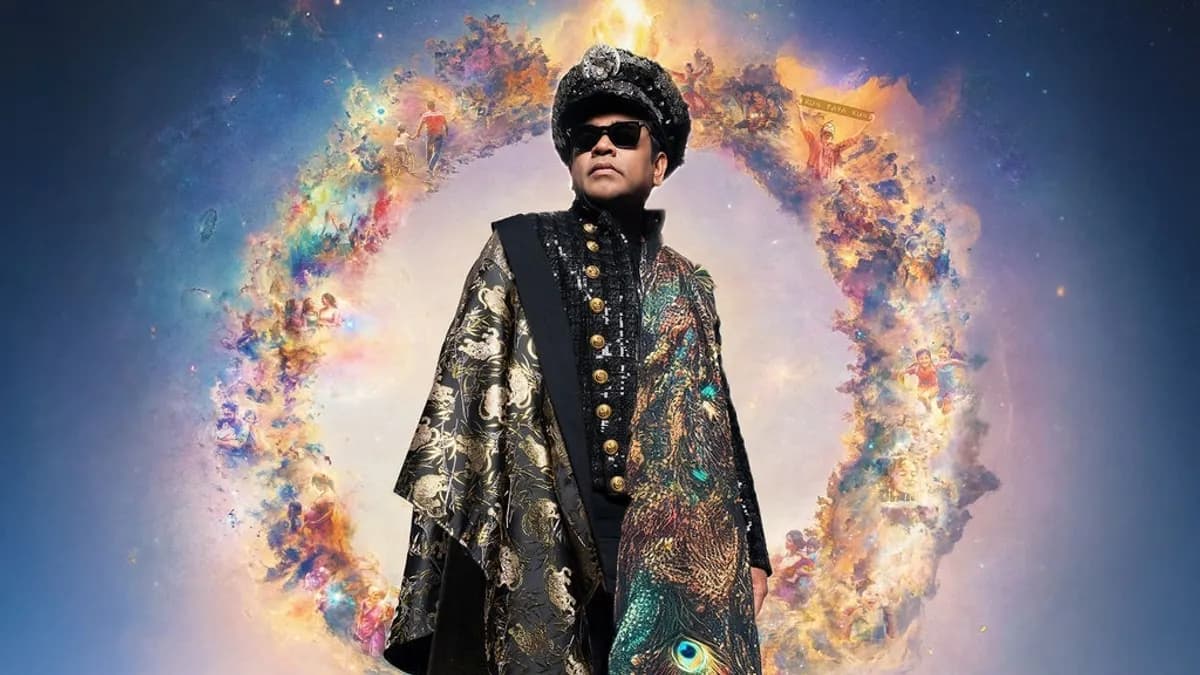
A.R. Rahman UK Tour 2026 — Dates, Venues & Tickets
A.R. Rahman UK Tour 2026 — All Dates
A.R. Rahman UK Tour — FAQ
How many A.R. Rahman UK tour dates are confirmed in 2026?▼
Where are the biggest A.R. Rahman UK venues?▼
How much are A.R. Rahman tickets in 2026?▼
When is A.R. Rahman's next concert?▼
Where is A.R. Rahman touring in 2026?▼
How do I get A.R. Rahman presale tickets?▼
Does A.R. Rahman do meet and greets or VIP packages?▼
How long is a A.R. Rahman concert?▼
Can I buy A.R. Rahman tickets on the day of the show?▼
Is A.R. Rahman coming to Canada in 2026?▼
Is A.R. Rahman performing near me?▼
What time does a A.R. Rahman concert start?▼
About A.R. Rahman
Allaharakka Dileep Kumar was born on January 6, 1967 in Madras (now Chennai), Tamil Nadu, to R.K. Shekhar — a film composer and conductor for Malayalam and Tamil cinema — and Kareema Begum (then Kashturi). He played his first keyboard sessions in his father's recording rooms before age ten, and following R.K. Shekhar's death in 1976 the nine-year-old Rahman supported the family by playing live keyboard for the touring South Indian session circuit and contributing to commercial-jingle dates around Madras. He studied at the Madras Christian College Higher Secondary School and the Padma Seshadri Bala Bhavan school, formed the early band Roots with M. Jayachandran and the Magic boys, and won a scholarship to the Trinity College of Music in London where he completed a degree in Western classical music. In 1989 he converted to Sufi Islam and took the name Allah Rakha Rahman — A.R. Rahman — after a sister's recovery from illness, a biographical detail he has discussed openly across interviews and which shapes the spiritual register of much of his catalogue. His first feature score was Mani Ratnam's Roja in 1992 — twenty-five years old, recording in his own Panchathan Record Inn home studio at AM Studios in Kodambakkam, Chennai — and the album sold over 2 million tapes inside India alone and earned him the National Film Award for Best Music Direction on debut. Bombay (1995) and Dil Se.. (1998) cemented his collaboration with Mani Ratnam; Taal (1999) with Subhash Ghai pulled him into Hindi-mainstream rotation; Lagaan (2001), Ashutosh Gowariker's Oscar-nominated Aamir Khan period epic, gave him his first international Academy Award attention. The cross to Western projects followed: Lord of the Rings: The Musical in London's West End (2007), the Andrew Lloyd Webber-produced Bombay Dreams (2002–04), and then the breakout. Danny Boyle's Slumdog Millionaire (2008) — for which Rahman wrote Jai Ho with lyricist Gulzar and Sufi-pop musician Sukhwinder Singh — earned him two Academy Awards in 2009 (Best Original Score, Best Original Song), two Grammy Awards in 2010 (Best Compilation Soundtrack, Best Song Written for Visual Media), and a Golden Globe, making him the first Asian to win a Best Original Score Oscar. He has since scored 127 Hours (2010) and Million Dollar Arm (2014) for Hollywood, returned consistently to Indian projects, founded the KM Music Conservatory in Chennai (2008) to train South Asian musicians in Western classical and Indian classical traditions, and built a parallel philanthropic and cultural arm through the A.R. Rahman Foundation. He composed Maa Tujhe Salaam — the 2007 patriotic anthem that became one of the defining Indian national-pride compositions of the post-Vande Mataram era — and Jiya Jale, Chaiyya Chaiyya, Tu Hi Re, and the Roja Janeman cycle that defined his early Mani Ratnam years. His son AR Ameen and daughter Khatija Rahman are both performing musicians in their own right and frequently feature on the Rahman touring roster. Awards: 6 National Film Awards, 2 Academy Awards, 2 Grammy Awards, a BAFTA, a Golden Globe, 15 Filmfare Awards, 17 Filmfare Awards South, the Padma Shri (2000), and the Padma Bhushan (2010) — the broadest cross-genre and cross-language honours catalogue any Indian musician has assembled.